


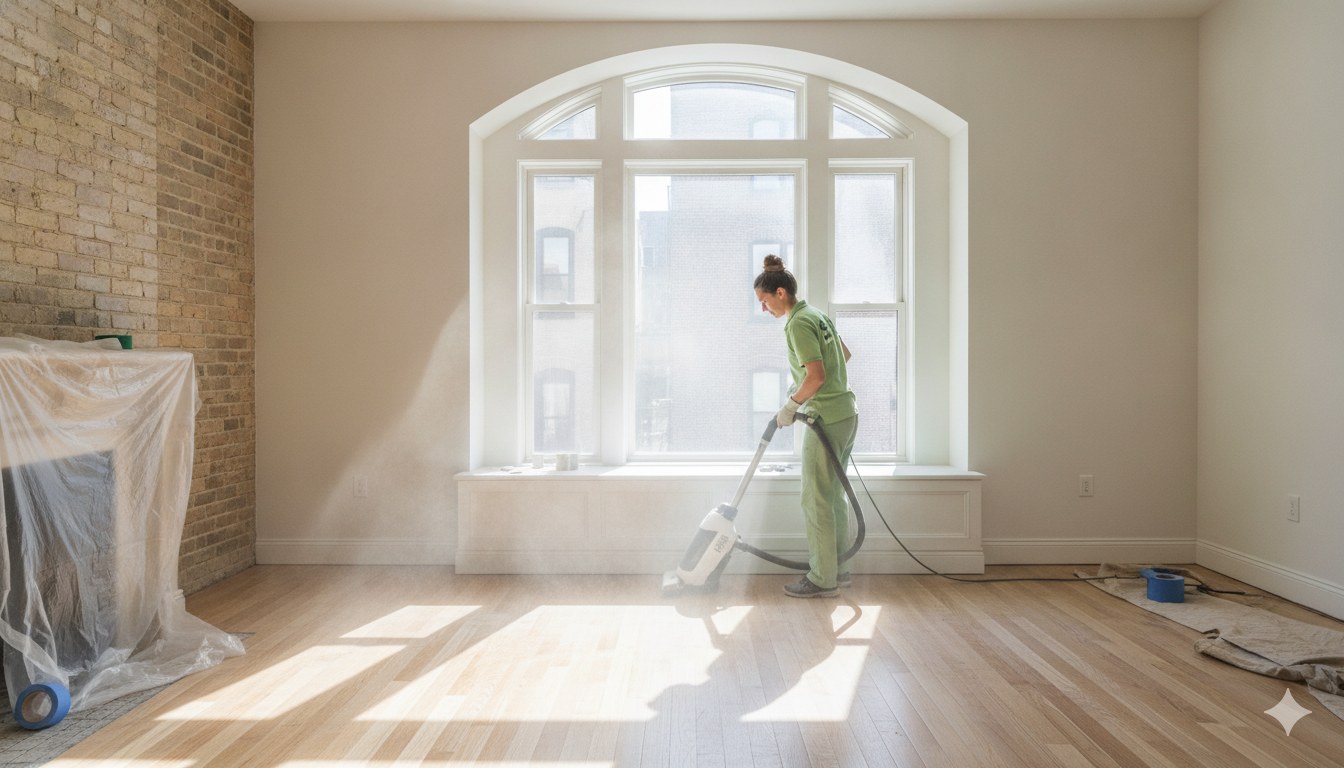
Every June and July, we get a surge of calls from the same kind of client: someone who just watched their contractor pack up the last toolbox, swept the visible dust off the floor themselves, and then sneezed for three days straight. They figured the apartment was "mostly clean." It wasn't.
Post-renovation cleaning in a NYC apartment is different from a regular deep clean — and it's different from what most people expect. Over the years of cleaning freshly renovated apartments in Manhattan, Brooklyn, Queens, and the Bronx, we've built up a very specific picture of what contractors leave behind. This post is about that picture.
If you've just finished a kitchen gut, a bathroom retile, or a full-unit renovation, here's what's actually waiting for you — and what a proper post-construction cleanup looks like.
Renovations tend to cluster around summer for a few reasons: tenants are more likely to vacate during warm months, landlords time work between lease cycles, and contractors have more daylight. In our experience, we do roughly 40% of our annual post-renovation cleanups between Memorial Day and Labor Day. The heat compounds the problem — with windows open for ventilation, fine drywall and plaster dust doesn't just settle, it migrates into rooms that weren't even touched during the work.
This is the defining challenge of any post-renovation cleanup. Drywall dust is talc-fine — particle sizes measured in microns — and it finds its way into HVAC registers, behind radiators, inside cabinet hinges, and under the refrigerator. Standard vacuum filters don't catch it; they recirculate it. A proper cleanup requires HEPA-filtered equipment with sealed suction paths. We've walked into apartments where the homeowner vacuumed for two hours before calling us, and the air quality monitor still showed elevated particulate levels.
After a bathroom or kitchen retile, grout haze — a thin whitish film — coats every nearby surface if it wasn't wiped immediately. On unsealed stone countertops, cured grout haze requires an acid-based cleaner and a careful hand. On older NYC ceramic tile (common in pre-war buildings), it can look like the tile itself is damaged. It isn't — it just needs the right approach and patience.
Even careful painters leave microdroplets of paint on fixtures, glass, and hardware. We find dried paint on faucet handles, window glass, outlet covers, and door hinges in nearly every post-renovation job. These don't come off with a damp cloth — they require a razor scraper on glass and mineral spirits or specialized paint removers elsewhere, always tested first on an inconspicuous spot.
New paint and construction adhesives off-gas volatile organic compounds (VOCs) for days to weeks after application. You can smell them, but they also settle on surfaces as a slightly sticky or oily film. This needs to be cleaned with a gentle, non-solvent solution to avoid re-dissolving the finish underneath. This is one area where eco-friendly, non-toxic cleaning products genuinely outperform conventional heavy degreasers: they lift the film without damaging the new surfaces you just paid to install.
Window AC units are particularly vulnerable. Renovation dust enters through the fan intake and accumulates inside the coil. If you run your AC before cleaning the unit, you redistribute that debris — and potentially mold spores — throughout the apartment. Window tracks also collect fine grit and debris that standard cleaning misses. We always disassemble window tracks and AC filter trays as part of our post-renovation protocol.
New surfaces are vulnerable surfaces. Fresh grout hasn't fully cured. New hardwood sealants need time to harden. Freshly painted walls with low-VOC latex finishes are easier to damage than they look.
Conventional cleaning products — particularly bleach-based cleaners and heavy-duty degreasers — can strip or discolor these surfaces. We've seen well-intentioned DIY cleanup sessions leave haze marks on new quartz countertops and dull the finish on brand-new hardwood.
Non-toxic, biodegradable cleaners clean effectively while being gentler on the materials your renovation just installed. They're also better for your air quality — after weeks of construction chemicals, the last thing your apartment needs is a cloud of synthetic fragrance and chlorine. For everyday eco-friendly cleaning products, our parent brand Everneat carries a curated selection of non-toxic home care formulas at everneat.co/shop.
A thorough post-renovation cleaning goes far beyond what a standard deep clean covers. Here's what a proper protocol looks like:
This is a 4–6 hour job in a standard NYC 1-bedroom. Larger renovations or full gut-renovations take longer.
Honestly: if the renovation was limited to one room and you don't have HVAC concerns, a thorough DIY cleanup is possible — provided you have a HEPA-filtered vacuum and patience. Work in passes: vacuum first, then wipe, then a final wipe 24 hours later to catch resettled dust.
For full-apartment renovations, gut kitchen/bath work, or any project that involved drywall, plaster, or concrete, professional post-renovation cleaning is genuinely worth it. The hidden dust in HVAC systems and behind fixtures is what causes ongoing air quality issues and, eventually, mold in NYC's humid summers.
If you're ready to come home to a clean apartment — not just a less dusty one — our team is available for post-construction cleaning across all NYC boroughs. Learn about our Post-Construction Cleaning Service.


-01.png)


