


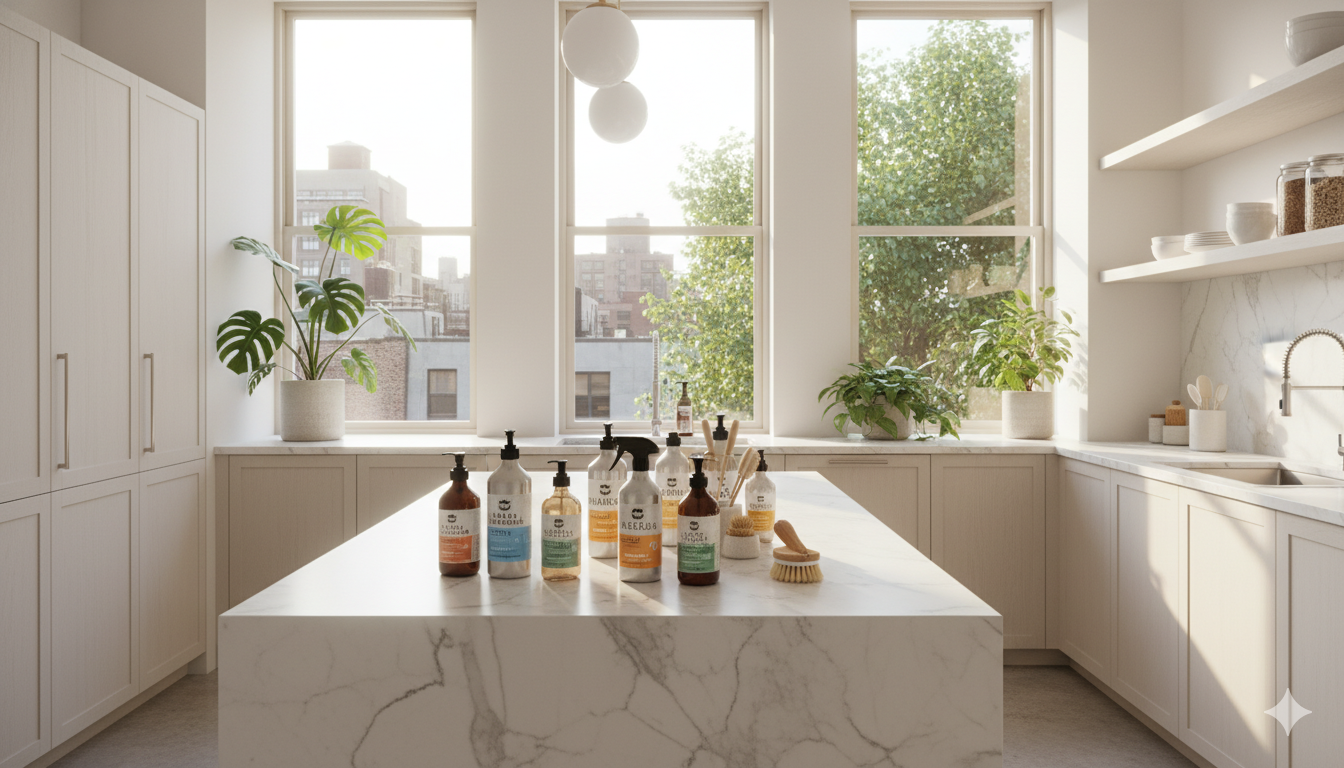
Booking a cleaning service in New York City sounds simple until you realize how many options exist and how few are what they claim to be. "Green," "eco-friendly," and "non-toxic" appear on dozens of NYC cleaning websites, but they're largely unregulated terms. No certification body verifies those claims before a team walks into your apartment.
This guide is for NYC residents who want a service that's genuinely safe — for your home, your family, your pets, and the building you live in — and who want to know how to tell the real thing from the marketing version.
The term "eco-friendly" has no legal definition in the cleaning industry. Any company can use it. What actually matters is what's in the products and how the team is trained.
Look for services that use products certified by one of three credible standards: EPA Safer Choice, EWG Verified, or Green Seal. These certifications require third-party ingredient testing and prohibit known carcinogens, endocrine disruptors, and volatile organic compounds (VOCs). If a service can't name the certification on their products, the "eco" claim is marketing, not substance.
Beyond ingredients, ask whether the team uses microfiber cloths instead of disposable paper towels, concentrates that reduce plastic packaging, and HEPA-filtered vacuums that capture fine particulates rather than recirculating them into the air.
Manhattan, Brooklyn, and Queens are full of pre-war buildings with specific needs most generic services aren't trained for. Marble countertops, plaster walls, original hardwood floors, and penny tile all require different approaches. An acid-based product safe on modern tile can etch marble permanently. A heavy-duty floor cleaner safe on polyurethane will strip oil-finished hardwood.
Ask specifically how a service cleans marble and stone surfaces, what products they use on hardwood floors, and whether their team identifies material types before choosing products. A generic answer likely means one product applied to everything — a real risk in NYC's older apartment stock.
Non-toxic cleaning means products safe to breathe, touch, and have around children and pets after the team leaves. The key word is after. Many conventional products are technically safe once fully dried, but leave residues on high-touch surfaces — counters, doorknobs, toys, pet beds — that accumulate with repeated exposure.
True non-toxic cleaning uses formulas safe at the point of contact, not just after a waiting period. Plant-based surfactants, probiotic cleaners, enzyme-based formulas, and essential oil disinfectants all qualify. Ask a potential service to share their product list or safety data sheets. Reluctance to do so tells you something.
The quality of any eco-cleaning service is only as good as the team executing it. NYC has a large informal cleaning labor market where workers are classified as independent contractors, paid in cash, with no training accountability. This creates inconsistency — teams change week to week and are difficult to hold accountable.
Look for services that hire cleaners as W-2 employees, pay above minimum wage, and provide structured training on both technique and product safety. A trained, stable team will know your apartment, handle your belongings with care, and be accountable when something goes wrong.
NYC apartments accumulate grime faster than larger homes. Smaller square footage and city air carrying daily particulates mean a weekly or biweekly schedule is standard for most apartments. Monthly deep cleans work for residents who maintain the space in between.
The right cadence depends on apartment size, pets, children, and foot traffic. A credible service will assess your situation rather than defaulting to their most profitable package. If the first thing they ask is your budget rather than your apartment type, that's a signal about their priorities.
Ask for their product list or safety data sheets. Any service claiming to be eco-friendly should tell you exactly what they use. "All-natural products" without specifics is a red flag.
Check for specific reviews. Reviews mentioning the team's name, specific rooms, or how a problem was handled are authentic. Entirely generic reviews are harder to evaluate.
Ask about their guarantee. Reputable services will re-clean anything you're not satisfied with. Willingness to stand behind their work signals confidence in their training and products.
A legitimate eco cleaning service in NYC will be transparent about products, honest about pricing, consistent in team assignment, and trained on the specific surface types in your apartment. They'll use EPA Safer Choice-certified or equivalent products, explain what they're using if you ask, and leave your apartment with neutral air — no chemical fragrance masking cleaning residues.
Everneat was built for exactly this: NYC apartments, pre-war surfaces, genuine non-toxic formulas, and W-2 staff trained on material-specific protocols. Learn how Everneat cleans or explore the product line behind every service visit.


-01.png)


